Tuesday, January 15, 2013

Adventures with Gunpla Part I

Well, it's about time I took a break from writing about toku and started focusing on some of my other passions/hobbies.  As a lover of giant robots, I naturally over the years have assembled robot models from various franchises (mostly Gundam).  This entry contains reflections and pictures from my journey.

Origins


Many adventures have humble beginnings.  This one is no exception.  As a middle schooler, I got into the giant robot kick while watching Gundam Wing, which is fairly common among giant robot lovers in my age range.  Of course, when shiny Gundam Wing model kits started being released, I had to have one.  Not knowing anything about modeling or even much about Bandai's line of Gundam kits, I ended up buying several 1/144 scale kits.  These things weren't the nicer High Grade kits I would later become accustomed to.  I'm honestly still not sure what they're called...No Grade?  First Grade?  Crap Grade? 

Anyway, so I forced the parts out of the parts tree, snapped the suckers together, and lo and behold, they looked like disappointing plastic pieces of crap that vaguely resembled the cool picture on the box.  These debacles were nubby, unpainted, and falling apart, and it would be a while before I tried a kit again.  I wish I had a picture of one of these things.  I guess as a kid, I guess I missed the point of modeling.  If you wanted to buy a cool toy, buy a figure.  Modeling is a whole different ballgame.

Not one of my creations, but it's an abomination for sure.

The Fool Journeys Onward


In high school, I tried my hand at a couple of High Grade kits, mostly UC stuff as I moved away from Wing.  They were much better than the travesties I had assembled years ago, but I still didn't have much in the way of technique.  I think I would get excited and hurry through things, resulting in slightly better nubby debacles than before.   I don't think I was quite ready to invest time and money into Gunpla as a serious hobby, though my endeavors led to a few cool models that I wasn't ashamed to display on a shelf in my room.

In college I didn't really invest much into Gunpla.  When I moved away from my hickish hometown to Little Rock, I was at least able to visit hobby stores, where I finally bought a pair of nippers with which to cut out parts.  This drastically reduced nubbiness.  I ended up buying a MG Acguy.  It was my first MG kit, and it was a great experience, though I still had markings from using the nippers really close to the parts themselves.  I guess I was too dumb to look at a beginner's guide to Gunpla.  I probably thought I didn't need one since I had done these before.  Foolish.  At least I was improving little by little.

Trial and Error


I don't know why I often insist on winging it until I make a mistake.  Trial and error is really a poor way to learn something quickly.  During Round 2 of college, I finally decided to get serious about my modeling endeavors, so I loaded up on supplies from Hobby Lobby, made a few online orders, and I was soon back into Gunpla.  I finally decided to utilize paint, a modeling knife, and various other tools.  Why I didn't sooner is anybody's guess, really.

The first kit from my renewed modeling adventure actually wasn't from a Gundam series.  It was an HG Dunbine since I am rather fond of both the design and the show itself.  I then went all-out on a somewhat painful 1/100 L-Gaim kit, followed by a HG Gaplant, a HG L-Gaim, and an HG Aug.  The following are some of the things I have pondered, tried, debated, learned, and not learned during the course of building these kits.

Should I Go All Out?


When it's time to get serious about Gunpla, does it mean that you have to go out, buy an air compressor, a spray booth, and 15 types of chemicals?  Not at all.  There are some advantages to investing in some awesome tools, as they often allow you a wider range of effects and options for making a truly dynamic and epic-looking model.

There are some people that go all out on this stuff, and don't get me wrong, they make a magnificent model, but for those of us on a budget, who aren't ready for that step, or just like to do it differently, there's nothing wrong with doing it your own way as long as you put care and effort (and love?) into your work.

With that being said....

Gundam Markers?!


Yes, Gundam Markers.  These alcohol-based paint markers seem like an attractive option for folks getting into building some cool robot models.  When a beginner asks about whether or not to use Gundam Markers, I've seen a variety of answers, ranging from "OH GOD DON'T DO IT" to "Sure, they're okay."  Honestly, from my experience, I would say the best answer is, "Well, it depends on what you're doing."  Kinda vague, but I can give some examples.

If you need a wide area of coverage, don't use a Gundam Marker.  They can be very useful for small detailing, though.  There are really great for panel lining, which is practically a must for building a good looking model.

HG Dunbine

For my HG Dunbine, I experimented with using Gundam Markers quite a bit.  Using a pink Gundam Marker on some of the smaller parts added some great accenting, and it was quick and easy to use.  Also, I used a fine, black marker for the panel lining, which looks pretty good for a panel-lining first-timer.

However, the markers were a terrible idea in some spots.  Dunbine's feet were actually white coming out of the parts tree, so I used a large, black Gundam Marker for them.  It was fairly awkward and time-consuming, requiring many more layers than if I had just used some actual paint.  It would have been faster to just get a brush and paint the things, but at this point in my journey, I wasn't yet comfortable with a paint brush.  I also decided I didn't like the clear green on the sides of the cockpit, and I wanted to make it look more like the image on the box, and so I used the black marker on that as well.  What I didn't foresee is that the marker didn't adhere very well to the smooth clear plastic and ended up kinda flaky to the touch.  Oops.

I now use Gundam Markers sparingly.  One of my favorite uses was for my HG Aug.  This kit had a shiny metallic coating, and no matter how careful I tried to be, it seemed nearly impossible not to blemish the coating where the parts were trimmed from the tree.  I used a metallic gold and a metallic silver Gundam Marker to add a quick-fix touch to those spots.  It wasn't a perfect solution, but it turned out much better than if I had not used them.

HG Aug.  You can see the spots where I touched it up with Gundam Markers.  Not awesome, but not the worst fix.


HG vs MG vs Whatever Else


Another thing I had to settle on was choosing between High Grade kits and Master Grade kits.  HG kits are usually pretty solid in terms of articulation, are about the size of a typical action figure, and are pretty affordable, usually in the $15-$30 price range.  MG kits, on the other hand, are bigger, have better articulation, and come with cooler decals and effects parts.  They are also quite a bit pricier than HG kits, costing in between $40 and $60 for the average MG kit.

Right now, I prefer HG kits for a number of reasons.  It seems like more of a challenge to get them looking awesome, so they appeal to the part of me that wants to improve my skills.  They are also pretty cheap, so if you mess up by breaking a part, botching the paint job, or some other mishap, it's not really a big deal.  Their size is also good for me at the moment.  If I had a ton of MG kits to display, I would quickly run out of shelf space in my room. 
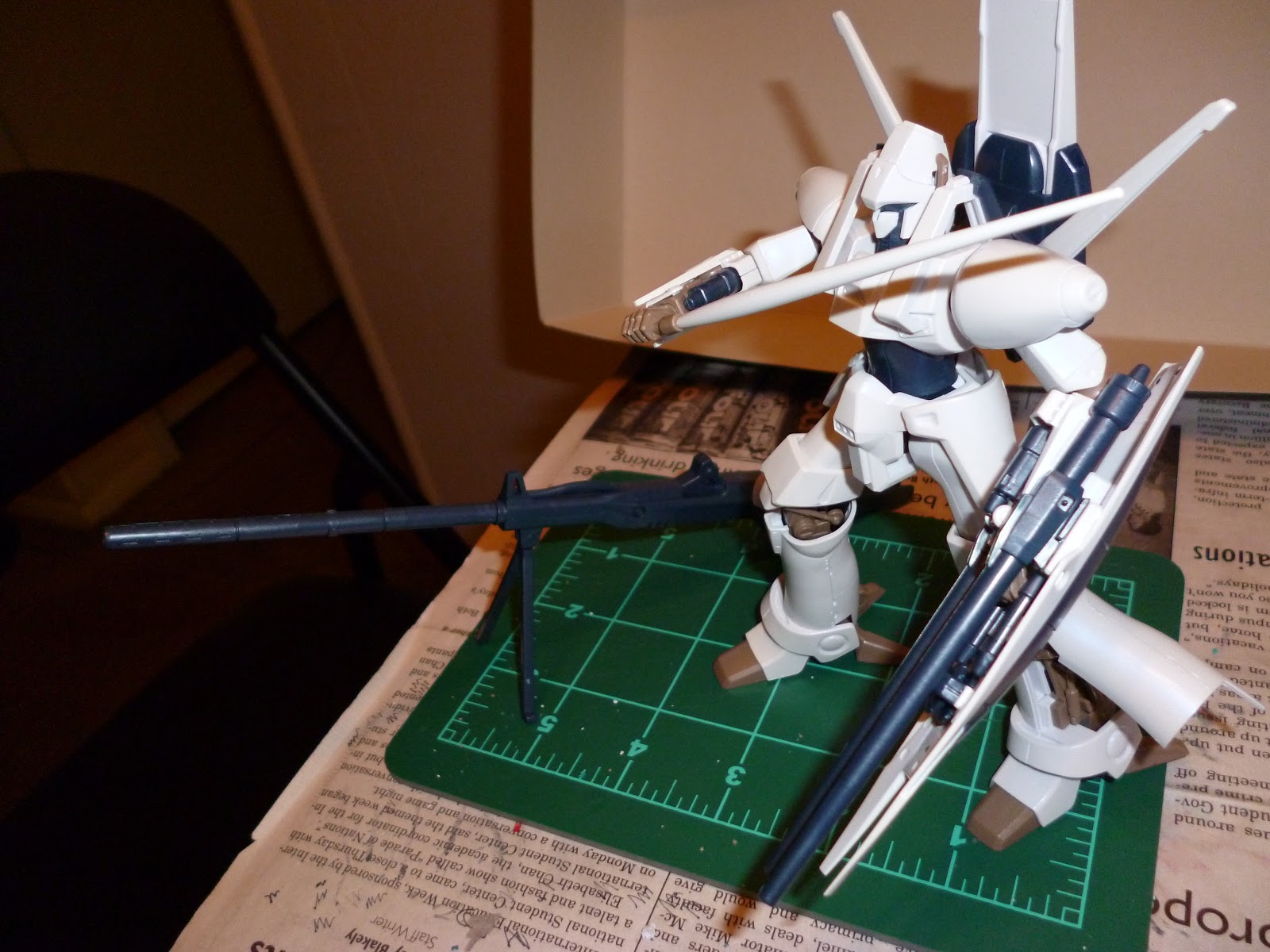
HG L-Gaim with heavy pearl coating.


However, MG kits are a blast to build, especially if you are interested in the inner workings of these robots.  They really give you an intimate look at how these machines are built, and of course, you have the cool part effects and decals.  At their price, I would be afraid to mess things up, so I would have to get a little more confident in my modeling abilities before I get some more MG kits.

Of course, there are also Perfect Grade kits, which are huge (usually 1/60 scale), absurdly detailed, and expensive.  I have not had the pleasure of building one of these beasts.  Maybe some day...  There is also the newer Real Grade kits, which provide a nice balance of size, articulation, and detail, though I haven't built any yet.

Painting with Acrylic vs Enamel


When I got more serious about Gunpla, I opted to use paints and brushes as opposed to investing in an air compressor.  As mentioned before, I wasn't confident in my painting skills, which is why I tried the Gundam Markers.  I had always sucked at painting, so I was leery of messing up my models.  Trying the brushes was a good idea in the long run, and it doesn't take long before you get used to being precise with them.

With paints, you have a couple of choices, including enamel, acrylic, and lacquer.  With my HG Dunbine, I tried some acrylic brown paint just for the wings, and I was really pleased with how it turned out.  At first, I used thin tape to section off the parts I was painting, which kinda turned out to be a waste of time as I learned how easy acrylic paint is to fix.  If you mess up, a lot of times you can just scrape some of the excess off with a modeling knife or even your fingernail, depending on how precise you need to get.  In addition, it doesn't take much effort to clean the brushes afterward.  Even though it's easy to apply and fix, it adheres to the plastic much better than Gundam Markers.


When I built my HG Gaplant, I decided to try enamel paints.  Going with enamel turned out to be a little more work.  You definitely need enamel thinner/brush cleaner on hand.  When enamel paints dry, they dry hard.  As such, fixing mistakes becomes a little more of a chore than with acrylic.  Another thing to consider is the shelf life of enamel paints.  It may only take a few months for a little bottle of paint to harden up on you, but then again, hobby stores sell them in really small bottles for pretty cheap.

Enamel paints create a nice, solid look and often have a nice sheen to them.  Enamel also lets you rest a bit easier about protecting your paint job, as scrapes and scratches don't seem to have much effect on the paint job, which I discovered when I tried to fix a sloppy spot by scraping at it with my modeling knife.

Between the two, I think I prefer acrylic paints, but it may just boil down to whatever my mood is or whichever I think would look better on the model I'm currently working on.  I haven't had a chance to mess with lacquer paints yet.

Top Coat Stupidity


A nice top coat can really make a model look fantastic.  It helps to take away some of that cheap, plastic look.  Options range from matte to semi-gloss to gloss.  I have used both matte and semi-gloss, depending on whichever I think will look better on my current model.

I have encountered one problem, though.  I suck at spraying things.  I never get it quite right, which is problematic when I go to apply the top coat on my models.  My HG Dunbine was one of my better efforts, but if you look closely, you can see some speckling on the legs from a slightly uneven coat.  Overall, it doesn't look too bad, and I really like the matte finish on it.


Afterward, I tried to make sure this didn't happen again, just to end up spraying too much top coat, which accumulates in certain spots and dries looking thick and boogery.  Also, it turns out that the alcohol-based Gundam Marker paint doesn't get along well with top coat all the time.  If you overdo it, the Gundam Marker will run, which can make your nice panel lines sloppier in the end.

I will keep trying to get my spraying technique down, because I really love the look that the top coat gives the models.

Doing Your Own Thing/Rolling With It


Sometimes, I decide to do something different than the instructions or normal painting scheme.  I'm a bit bi-polar when it comes to HG decals.  They tend toward being really shiny, which can look really out of place on a model.  On my HG Dunbine, I actually opted to paint the eyes instead of using the decals because I thought the shiny, glossy look wasn't really true the Dunbine's look and might look out of place with the matte finish.  (In retrospect, maybe it would made those eyes really pop.  Hmm.)  I also ended up using a brighter pink than in Dunbine's usual depiction.  I like how it turned out anyway.

When I worked on my HG Gaplant, I got the bright idea to use black Gundam Marker on the shoulders, which after over-spraying the top coat, ran like hell.  There wasn't really a good way to fix it, so I kinda rolled with it, using the Gundam Marker to continue the trail of marker.  Honestly, it looks kinda bad, but in the end, it's my own unique Gaplant, I guess.  The top coat also got pretty boogery in places.  The good news is that I discovered while in mobile armor mode, the shoulders face the other way, so the side that isn't messed up shows.  Needless to say, I like to keep my Gaplant in MA mode.  (The enamel paint looks great on it, though.)

Crappy phone photo of MG Gaplant.  You can see where I rolled with the marker "blood trail"
Many of the mistakes ended up less noticeable in MA mode.

The point is that you're gonna mess up sometimes, and if you can't fix it, you might as well roll with it.  Lastly, it's your model.  Customize it however you want.  That's part of the fun of these models.  You can really make them your own and add your own personal touch if you like.

I am currently in the process of building some HG Titans kits, starting with the RMS-106 Hi-Zack.  Adventures in Gunpla Part 2 is sure to happen eventually as I learn and experience more.  Until then, thanks for reading the reflections and musings of a guy who attempts to build half-way decent giant robot models.  Happy modeling!

Thursday, November 22, 2012

It's Space Time! Thoughts on Kamen Rider Fourze

Well, Fourze's been over for a while now, and I've been out of the blogging mood/busy for some time.  Now that I have some quiet time before Thanksgiving, I'll probably churn out a few thoughts on various things.  Why not start with some thoughts on Kamen Rider Fourze, since it's still fairly fresh in my mind?


Plot


Kamen Rider Fourze centers around the school days of punkadour-sporting Kisaragi Gentarou as he tries to make friends with everybody at Amanogawa High School, a place very much focused on space and science.  One of his first challenges is befriending Utahoshi Kengo, a somewhat sickly student whose late father worked on utilizing mysterious space technology known as switches.  Kengo isn't much of a fighter due to his poor physical condition, and he relunctantly lets Gentarou use the Fourze driver to power up and fight the Zodiart monsters that pop up at AGHS.


Fourze with Rocket and Drill switches activated.

The interesting part is that the Zodiarts have their own switches, and are usually AGHS students that have been tempted to use the switches' powers by the enigmatic Horoscopes, higher-ups in the Zodiart chain of command.  Gentarou and his ever-growing club of friends essentially save these stray students, defeating them to destroy the switches.


The first ten or so episodes focuses on Gentarou befriending the characters that come together to form the Kamen Rider Club.  They have a sweet base on the moon (The Rabbit Hatch), linked by portal to a locker in a largely unused back room of the school.  Kengo spends time at the Rabbit Hatch developing new switches for Fourze, based on his father's previous work.

Eventually, a new Rider shows up.  Ryusei Sakuta transfers to AGHS, wielding the power to transform into Kamen Rider Meteor.  He wishes to find the Aries Zodiart, as it may hold the key to reviving his comatose friend.  Under orders from Tachibana, a masked benefactor from the Anti-Zodiart Alliance, Ryusei is to infiltrate the Kamen Rider Club.  As a result, Meteor's identity remains a secret for quite some time.  Of course, even Ryusei isn't any match for Gentarou's friending abilities, and they go from rivals to close allies over time.

Your fate is mine to decide.

Things escalate as Gamou, the leader of the Horoscopes, gathers the Horoscope switches for his sinister purposes.  It's all pretty spoilerific, so I won't go into much detail.

Many early episodes of Fourze contain a combination of some of these events:  New Zodiart appears, The Kamen Rider Club investigates, Fourze fights the Zodiart and saves the switch user, Gentarou befriends someone (often the switch's user, even).  As previously mentioned, the first ten or so revolve around the students that join the Kamen Rider Club, so there's a lot of time devoted to getting the KRC set up, making it take a while for the plot to really take off.

Overall, the plot can be a bit formulaic, but that's fairly normal for toku.  Things get serious toward the end, but I couldn't help but feel that it was a bit rushed.  The series is also not quite 50 episodes.  I bet if they had a few more episodes or better utilized some of the less plot-driving episodes, the pacing would feel a bit more even.  I was a tad disappointed in the ending.  It seemed too...familiar in some ways, and it wasn't quite the epic conclusion I was looking for.

 Characters


Fourze has a large and interesting cast of characters.  The Kamen Rider Club seems to double as both a strength and a weakness for the show.  The interactions between the KRC members is enjoyable, but because of the larger cast, less time can be spent on individual character development.

Gentarou is an interesting lead.  His absurdly friendly attitude combined with his carefree, punkish look give him a distinctive feel.  He stands out quite well among the other Kamen Rider protagonists.  All of his actions seem to be motivated by friendship.  It's quite literally his source of power, as can be seen when Fourze's Cosmic States form debuts.  Gentarou doesn't have much of a background story, other than the fact that he lives with his grandfather, who is a goofball much like he is.  His development revolves around the friendships he builds with everybody else, but by himself, he's not terribly deep.


Kengo and Jojima Yuki are arguably the most important of the Kamen Rider Club characters.  Kengo builds a slow and reluctant friendship with Gentarou, but it becomes very strong later on.  He is the at the center of quite a few important plot developments.  Yuki is a goofy trainwreck of a girl, but is Gentarou's only friend at AGHS when the show starts.  She's obsessed with space and can be seen prancing around with her Hayabusa plush.  She's cute, especially when she mimics Fourze's transformation and poses, but she can also be annoying at times.


We also have Tomoko, the weird goth girl.  Scenes with her are usually pretty entertaining, and sometimes she even emits a tangible, creepy aura.  She's one of my favorite KRC members, and later seems to possibly have a bit of a thing going on with Ryusei/Meteor, but nothing really becomes of it on-screen.  Her keen insights help the KRC on several occasions.  There's also Miu, the bossy cheerleader and Queen of AGHS, who takes somewhat of a leadership position over the Kamen Rider Club.

Tomoko during one of her creepy moments.
Tomoko's reaction to people seeing her without makeup.
Honestly, she's quite attractive.

Anyway, enough Tomoko pics.

Of course, there are more KRC members, including Shun, the football player and King of AGHS.  He is portrayed as the typical jock at first, but turns into a useful member of the KRC, piloting the Power Dizer to help Fourze knock some sense into the Zodiarts.  Last but not least is JK, a cowardly, yet stylish guy that seems to know just about everybody.  The guy has some trust and friendship issues, but he is useful for digging up information.

Miu and JK.

Of course, Ryusei (Kamen Rider Meteor) later joins the gang.  He quite a prick at first, pretending to be a quiet transfer student to weasel his way into the KRC while actually being a spy.  He finds himself at odds with Gentarou and even fights him sometimes in order to accomplish his own goals/purposes.  Eventually,  his identity as Meteor is revealed (in epic fashion).  Gentarou shows Ryusei the ways of friendship, and they become close allies, with the KRC accepting him with open arms.

Ryusei's typical look of mild annoyance.

And that's just the Kamen Rider Club.  Most of the big villains are actually school faculty or administrators, though a student or two become Horoscopes as well.  Some of the teachers are good guys, though.  Mr. Ohsugi, for example, is a good-hearted guy that serves as comic relief (as if the show really needs it).  Almost every scene he is in is absurdly goofy, and he isn't terribly helpful.


Poor, heartbroken Ohsugi.

Overall, Fourze has likable characters, but perhaps too many of them.  When every KRC member gets a story arc or two to themselves, you can imagine how many episodes it takes up.  This kind of thing sometimes happens in Sentai shows where each of the characters gets rotated development arcs for awhile, sometimes resulting in the character development getting spread a bit thin.

Fights/Visuals/Music


The fights are one of the best things about Fourze.  Gentarou has a clumsy way of fighting that is entertaining to watch.  However, he makes up for his poor fighting technique by utilizing Fourze's many switches.  Gentarou ends up with many switches at his disposal, and he utilizes some interesting combinations.  However, the "regular" switches get neglected a bit as he obtains Electric, Fire, Magnet, and Cosmic States.  There are so many possibilities and combinations, but Fourze's powers get handled poorly as Gentarou later spams the abilities of Fourze's alternate states.

Fourze Cosmic States

Ryusei, on the other hand, is quite the martial artist.  He goes full Bruce Lee mode, complete with "Wacha!" sounds.  Unfortunately, like with Fourze, Meteor's powers are handled poorly, in my opinion.  He has some nifty planet powers that he can imbue his fist with, but he uses them only at first, and they seem to mostly be forgotten later for some reason.  Meteor actually isn't around too long before he get his upgraded form, Meteor Storm, which utilizes a rod with a beyblade-like top attachment that he can fling at enemies.  Honestly, I think the Meteor Storm form is pretty ugly.

Meteor Storm

Some Kamen Rider fans were repulsed at the suit designs for Fourze.  I admit that they were a bit odd at first, but I grew to like Fourze and Meteor's base forms in particular.  Fourze's alternate forms are okay, though Cosmic States is easily the coolest.  The Zodiart designs are rather cool as well.


The special effects are fairly solid throughout the series.  There are quite a few space scenes and battle effects that make heavy use of CG, but overall, it is done well (for toku), at least in comparison to some of the earlier Heisei Kamen Rider shows.

The music in Fourze is pretty good and feels appropriate.  The BGM utilizes an upbeat, electronic feel, though I can't say that many BGM tracks stand out to me.  The opening is fun and catchy, but the ending themes were hit or miss for me me.  Giant Step and Cosmic Mind are easily my favorite picks.

Conclusion


Kamen Rider Fourze is a fun romp.  It can get a bit tiresome in spots, but it managed keep me mostly entertained week after week.  Unfortunately, it does suffer from some issues that were poorly-handled, as mentioned earlier, and I'd say that it isn't nearly as strong as W or OOO, but it's certainly not a bad entry in the Kamen Rider series.  It's worth a look, and should definitely put a smile or two on your face.


Friday, July 6, 2012

A Book of Cosmic Power

In a time where a sadly large portion of my inspiration comes from a number of superhero shows aimed at Japanese kids, every once in a while I come across something that truly speaks to me.  I'll admit that through the years, I haven't exactly been an avid reader, which is somewhat disappointing, considering that when I was a kid, I would have been considered a bookworm.  It was probably the years of intense study, where the only books I had time to read were the ones that I was required to read for classes, and most of those were technical in nature.  In other words, school completely killed my desire to read.

Whenever I have slowly picked at books for my own reading pleasure in recent years, I have have only read works of fiction.  Even then, it seemed like I had to force myself a bit, like I was relearning how to read for pleasure and not for some looming and urgent assignment.  After being away from classes for a while, I think I started to crave some mental stimulation, so I ended up buying a copy of Cosmos by Carl Sagan to nourish my brain.  I had always liked Sagan, ever since seeing an episode or two of the Cosmos TV series some time ago, and I figured that it would be an interesting and engaging read, but nothing would prepare me for the epic journey across time and space that would follow.


One of my favorite things about this book, and one of the first things any reader would notice, is how Sagan's writing is not only fairly easy to read and follow, but is very poetic as well.  There are so many quotable lines in any given chapter.  The awesome John D. Boswell of Symphony of Science took full advantage of this, as many of his songs consist heavily of auto-tuned Sagan quotes from the Cosmos TV series, most of which correspond directly to the book.  Here's but a small snippet of the billions and billions of notable quotes:

“If you wish to make an apple pie from scratch, you must first invent the universe.” 

"The beauty of a living thing is not the atoms that go into it, but the way those atoms are put together."

“The nitrogen in our DNA, the calcium in our teeth, the iron in our blood, the carbon in our apple pies were made in the interiors of collapsing stars. We are made of starstuff.” 

“The absence of evidence is not the evidence of absence.” 

Sagan has a gift for turning things we consider mundane, things we take for granted all too often, into something thought-provoking and meaningful.  He makes you stop to consider so many things, from the universally-large to the infinitesimally small.  Within the first chapter, I stopped and thought about how the trees are our cousins, how we share a good portion of our DNA with not only monkeys, but the bananas they are so fond of as well.  You get a good feel for how far we've come and how amazing life is.  It's a very inspiring thing, to look at all of the things in the cosmos that Sagan decides to highlight in this book.


I wouldn't call my experience with Cosmos to be absolutely perfect (Nothing really is).  There are some portions that interested me quite a bit, and some other portions not as much.  I believe that comes down to personal taste and interest.  For instance, the passages about evolution, the surface of Venus, time dilation, and black holes were some of the most riveting during the course of my cosmic experience, while some of the other passages dragged a bit.  Somebody else may be glued to different sections.  The final chapter wraps everything up beautifully though, never ceasing to be poignant and thoughtful.

Overall, after reading Cosmos, I feel enlightened and invigorated, like the cosmos is calling me to a higher, more meaningful purpose. I only hope that my infinitesimally small speck of cosmic consciousness can contribute something meaningful to our tiny corner of the universe.

I saved one Sagan quote for last.
“One glance at a book and you hear the voice of another person, perhaps someone dead for 1,000 years. To read is to voyage through time.”
No matter how demoralizing your studies get, no matter how sidetracked you get with life and modern distractions, always try to find time to read something for yourself (especially from the non-fiction section).  You will be a better, more enlightened person for it.  READ A BOOK.

Billions and billions of books!!

Tuesday, April 3, 2012

"Don't give up!" Thoughts on Ultraman Nexus.


Of all of the major tokusatsu franchises, the one I have the least exposure to is the Ultraman series.  A while back, I bought the original series boxed set for around $5.  I found it to be a fun distraction, though it was far too much of an old, episodic, monster of the week type of show to watch in large doses.  I never quite got through it all the way (a sad tragedy that will have to be remedied), and I never really got into other Ultra shows.

I read some board suggestions for the Ultra series, and managed to snag some subs for Ultraman Nexus, one of the more recommended entries.  Sadly, these subs sat in a folder on my hard drive for quite some time, until recently, when I had burned out on Sentai and Kamen Rider enough to seek some other toku entertainment.  It only took a handful of episodes of Nexus before I was absolutely hooked.

Komon: pretty average dude.

We start the show with Komon, our main character, failing kinda hard at a rescue team mission.  Despite his failure and his thoughts of quitting his job, he is approached by the chief of a secret organization called TLT.  The chief is interested in him for some reason and wants to see if he is up to the task of being part of their special Night Raiders task force.  TLT's purpose turns out to be the extermination of space beasts while keeping the public from knowing anything about monster attacks and other incidents.  To help them with this, they even have Memory Police, who can erase people's memories Men In Black style. (Except with just their cell phones.  Nifty.)

Komon is such a likable guy.  I know I say that about most of the leads of these shows, but he is very kind and legitimately wants to help others, hence his rescue team job.  He can be a bit clumsy and awkward, but in a realistic, average guy kind of way.  He gets a lot of moral support from his girlfriend, Riko, who is very beautiful and sweet.  They always have nice conversations at the zoo, where she likes to work on her art.  His relationship with her is both believable and a bit heartwarming.  Watching them actually made me sigh and made me wish I had a Riko of my own...  She is more important to the plot than anybody realizes at first, which is interesting and also very unfortunate...

The cute couple.


While he is on his way to his training at the TLT HQ, Komon finds out firsthand the threat of the space beasts, as he is attacked by one.  He is unexpectedly saved by a silver giant, who is none other than Ultraman Nexus.  --What, the main character isn't Ultraman?  Interesting and unexpected for sure.  Anyway, we get to watch Komon struggle through Night Raider training and get acquainted with the other members, including Nagi, a harsh and experienced woman with an intense hatred of any creature from space.  Komon's interactions with her are something else.  She's always full of harsh "advice" for the newcomer and is very judging and bitter.  As the story unravels, we get to see her relationship with Komon develop quite a bit, and we find out many things about Nagi's past.  The other members are all likable in their own ways, though they are bit less developed (though not neglected).


Nagi, y u so hateful

We do meet the human form of Ultraman Nexus, a man named Jun Himeya.  This guy has quite the tragic past, and carries a heavy burden as he struggles to figure out the meaning and purpose of the powers that were bestowed upon him.  The guy is inspiring, epic, and completely badass (for Komon and viewers alike).  Of course, Komon completely trusts and believes in him and Nagi wants to blow his brains out for taking the form of a space creature.  Fun times.  As Ultraman, Himeya provides an invaluable asset to kicking space beast butt.  This unfortunately does not mean that his is treated with respect and trust from TLT, which occasionally orders the Night Raiders to shoot him.  More fun times.

Himeya's packing too.


I will note that to my joy and surprise, the Night Raiders aren't useless onlookers to Ultraman's battles.  They actually have decent fighting capability on foot and in their aircraft.  They regularly hurt the space beasts, and even destroy a few.
Anyway, the plot thickens many, many times, with quite a few twists throughout the series.  It isn't really apparent who/what is pulling the space beasts' strings until fairly late in the show.  Ultraman Nexus also has many characters who at first seem suspicious that turn out to be decent people, and it also has people that you think nothing of until they show their true colors in sudden and often devastating ways.

Without a doubt, Nexus has some great writing.  I think that I was immediately surprised by the character depth and the more realistic, adult relationships depicted in the show.  Nexus is also pretty dark and insanely epic at times.  I do know that it was aimed at more of an adult audience than previous Ultra shows, but what kills me is that the series had to be wrapped up a bit early due to low ratings.  This is quite unfortunate, as the ending seems a bit rushed.  Nexus was great, and it would have been even better if had gotten a full 50 episodes, but as criminal as it seems, that's how this industry works.  I guess it just didn't capture its intended audience, and I am pretty sure that it had a cruddy time slot.  Dayum shame.

Before I wrap things up, let me address the fighting scenes and the music.  The fighting scenes were well-choreographed.  I didn't notice any obvious and deliberate positioning or footwork that resulted in fake-looking or convenient fights.  I have seen this in some Ultra shows, and while toku is full of fun and silly fights (especially the older shows), it's nice to be able to take it seriously sometimes.


The music for Ultraman Nexus was composed by Kenji Kawai, who has worked with Mamoru Oshii on many of his films, including Ghost in the Shell.  The soundtrack for Nexus is epic and wonderful.  Many of the tracks are variations on the Nexus theme, but they are all different and great in their own ways.  Himeya's theme is incredibly touching and sad, and the Night Raider themes get the blood pumping.  This is one of those times where I immediately went out and found the OSTs.

Overall, Ultraman Nexus is a fantastic show.  Just about everything about it is well-done, including the plot, the characters and their development, the fights, and the music.  The only complaint I can come up with is that it is tragically a bit rushed toward the end, and I also found the "Second Season/Blue Nexus" portion to be a little underwhelming after becoming attached to Himeya and witnessing his amazing struggle.  The show never stops being good, though.  In my opinion it is tokusatsu at its finest, and it is definitely one of my new favorites.  Watch it.  Now.

Nexus is a cool guy.

Could it be Golgom? Thoughts on Kamen Rider Black


Aside from the stuff made available in America, Kamen Rider Black is the first toku show that I got into.  Some people suggested it as a decent starting point for getting into Kamen Rider, and I thought the designs were cool, not to mention that the title carried with it an implication that it was a bit of a darker entry in the series.

I have been picking at Black for quite some time, as Century Kings has been slowly churning out episodes throughout the span of several years.  (No hating on Pal, he did a great job.)  CK finally finished all of the subs, so after seeing all of the episodes, I feel like I can give some thoughts on the series as a whole.

The series starts out with a feeling of darkness and desperation, as we see Minami Kotaro running and hiding from three floaty priest-looking dudes.  You quickly find out that they don't want to kill him.  Rather, with the help of his foster father, Kotaro has escaped the evil organization, Golgom, and they want him back because they have modified him to be Black Sun, one of the two century kings that will battle to become Golgom's new creation king.  During this pursuit, which is full of cheesy but lovable mid-80's special effects, the Golgom priests eventually catch up with Kotaro. After getting smashed through a wall, Kotaro emerges all steamy-like as the transformed Black Sun.


Long story short, he proves to be difficult to capture in this new form, and vows to stop Golgom and rescue his friend/stepbrother, Nobuhiko, who is being transformed into the other century king, Shadow Moon.  He takes the name of Kamen Rider Black and becomes a friend of justice, stopping Golgom's crazy plots and annihilating their mutants.

Minami Kotaro is a likable guy, and he possesses many of the heroic qualities of his Kamen Rider predecessors.  One thing in particular that I love about Kotaro is his intensity.  He has that way of getting visibly angry about Golgom's latest plot, glaring, yelling something about how it is "Unforgivable!", and clenching his fists, which often begins the Black transformation.  I think that Tetsuo Kurata deserves a lot of credit for his acting as Minami Kotaro.  He is truly great.  Even the Black transformation itself is a bit intense, with the snappy arm movements, and the steam erupting from Black's armor.  The whole package is just pure badassery.

Intense

Kotaro is not alone, however.  Kyoko, Nobuhiko's younger sister, is essentially Kotaro's sister as well, and she is one of his few sources of support, even if his struggles as Kamen Rider Black are unknown for the majority of the show.  Also there for Kotaro is Katsumi, Nobuhiko's girlfriend.  She has no idea what happened to Nobuhiko at first, and the revelation of Nobuhiko's fate becomes a very important event in later episodes.

Black's fight sequences can be a lot of fun, sometimes a little silly or awkward, and sometimes surprisingly brutal.  Black himself has a very rough and tumble kind of fighting style, and he utilizes plenty of grappling and throwing.  He has a number of special attacks, many of which are only used once, unfortunately.  His Rider Punch and Rider Kick are the staple moves, and they get upgraded to more powerful, seizure-inducing versions later on.  (I'm just kidding about the seizures, though the effects are really bright and flashy.)  The fights do tend to get a little bit repetitive, though Black gets beaten up quite a bit.  When he's in a jam, he relies a lot on Battle Hopper, his bro-tier, sentient grasshopper bike.  Later in the series, he gets a second bike, Road Sector, which drives at ludicrous speed and can pretty much drive straight through anything.


It's easy to start comparing Black to both Showa and Heisei shows, simply because it's kind of that awkward middle child.  It's right at the end of the Showa era, and Black RX is the only show that separates it from Kuuga, the first Heisei series.  RX is arguably Black Season 2 anyway.  I think viewers going from mostly Heisei shows to watching Black may feel underwhelmed, especially since the show gets some hype.  The special effects are, of course, not going to be as great as modern shows, and the plot is more episodic, with less of that J-Drama type stuff that many Heisei shows exhibit.  On the other hand, viewers that have seen mostly Showa era shows may hone in on the fact that for its time, Black is a darker, more serious series with special effects that are an improvement over previous shows.


One main criticism of Kamen Rider Black that I've heard expressed is that the show pretty much hits a plot brick wall for half of the series, until Shadow Moon shows up.  This is somewhat true.  The plot is very slow, and the show is susceptible to Golgom crazy plot of the week + monster of the week kind of shenanigans, though honestly, all of the Showa Rider shows are like that, so my comments above apply here as well.  In any given episode, Kotaro will be just riding through town, and something slightly out of the ordinary will just happen to occur in front of him, prompting him to ask, "Could it be Golgom?!" or some variant of that.  And of course, it turns out to be a zany Golgom plot every time.  It's actually fairly amusing.


The show tries to change things up a bit in the first half by introducing Sword Saint Birugenia, a would-be Golgom century king who is risen after thousands of years.  The guy is really tough, and he definitely has something to prove, going way out of his way to show up the Golgom priests.  There are also a couple of kidnapping plots by the priests to use Kyoko's life force to speed up Shadow Moon's birth.  Of course, once Shadow Moon finally awakens and the Golgom priests get upgraded, the plot moves much more quickly until the end.

Sun, I am disappoint.

Now, onto the music.  The opening and ending songs for Kamen Rider Black are great.  Tetsuo Kurata wasn't exactly Japan's next singing idol, but he did a great job of making his own theme song sound epic and badass, especially when he's in the deeper portion of his range.  There are also many insert songs, all sung by Toshiya Igarashi.  Henshin! Rider Black is a favorite of mine.  It's a treat when they use it alongside the transformation sequence.  The BGM for Black is pretty good as well.  It wasn't anything that made me want to go out and immediately find the OST, but it was pretty epic and appropriate for the feel of the show.

Hmm, after I talk about the music, that usually means I've run out of things to talk about, so time to wrap it up.  I may be a little biased since Kamen Rider Black was my first Rider show, but it definitely stands out as one of my top picks.  I won't call the show itself my absolute favorite, but Kamen Rider Black is probably my favorite Rider.  That being said, go out and give it a try if you haven't already, whether you're coming from Heisei or Showa or even no Rider shows at all.

Tuesday, February 7, 2012

Anything Goes: A Look at Kamen Rider OOO

What, ANOTHER toku post?  Well, after watching Kamen Rider W, I quickly moved onto OOO so as to "catch up" in between the weekly episodes of Fourze.  I think I blew through it even quicker than I did Double, so I guess that immediately says something positive about the show, since I'm not the kind to force myself to sit through 50 episodes of a show I'm not enjoying.  Without further ado, here are some thoughts.


The plot of Kamen Rider OOO is a bit...different.  Creatures called Greeed, which exploit people's desires in order to sustain themselves, are unsealed after hundreds of years in confinement.  These desires gain them some satiation in the form of cell medals, but their main life force and source of power, however, comes in the form of core medals.  One of the Greeed comes in the form of a disembodied, floating monster arm.  This is Ankh, who proceeds to give our hobo hero, Eiji, the means to transform into OOO, primarily to gain assistance in collecting his own medals.


Ankh makes this complicated by possessing the body of a dying police detective, which is great for getting around.  However, Mr. Detective's sister, Hina, gets involved when she sees her brother's form (albeit with crazy hair) and develops a close relationship with Eiji and even Ankh to some extent.


The plot pretty much turns into a rat race for a good portion of the show, with Greeed constantly betraying other Greeed to get their hands on their core medals and Eiji defeating their Yummies, manifestations of a human host's desires.  Medals come and go, and the plot thickens when Dr. Maki, a strange scientist with a doll perched on his arm, sets a world-ending scheme into motion, intending on using the Greeed and the medals as a catalyst.

Also heavily involved in this whole medal-gimmick is the Kougami Foundation, whose president, called Cakeboss by many fans, is constantly seen making a cake for some occasion.  The power and funding of this organization can be both a great help to Eiji and Ankh or an annoying setback, depending on how El Presidente decides to play his hand. 

SUBARASHII!

The foundation's investment, along with Dr. Maki's brains, also results in the creation of Birth, a modular and mechanized suit that is fueled by cell medals (as opposed to OOO and core medals).  Akira Date, a bro-tastic former combat medic, dons this suit to collect cell medals for the foundation, and he usually ends up assisting Eiji and Ankh in their fights, taking all of the cell medals in the end, of course.  Assisting Eiji and Date is Gotou, a Kougami employee who wishes to save the world.  He comes across as a bit prickly at first, but comes into his own as the series progresses.   That covers many of the plot basics, though things thicken up as it moves forward.  Let's proceed on to the characters.

"Gotou-chan, NICE!!"

The characters in OOO are probably one of its strongest points, IMO, at least in terms of likability.  How they are handled is a different story.  Anyway, I think I found a reason to like just about all of them, even the Greeed.  Eiji is sort of an amicable hobo Jesus.  He's appreciates the simple things in life, like having clean, flashy underwear and some spare change.  At the same time, the guy is almost completely selfless, wanting nothing more than to help other people.  He never really thinks of himself, which is an issue brought up several times during the course of the show.  Unfortunately, there are a couple of show-stealers to contend with in OOO, so Eiji's status as the main character loses a bit of its kick at times.

Hobo Jesus and Brotou.

One of the show stealers is Ankh.  The guy is a complete prick through 90% of the series, and yet, I couldn't help but like him and be completely enthralled with his time on screen.  Maybe it's Ryosuke Miura's solid performance as an actor that grabbed my attention.  It also could be that Ankh is just more interesting than Eiji in several regards.  Throughout the show, he actually experiences some very important character development that never quite comes to light until near the end, partly because it's in his very nature to suppress any emotion or action that doesn't make him look like a complete turd.  Every once in a while, something more trickles to the surface, and it makes him incredibly intriguing.

Gonna stab you so hard...

The other big show stealer is Date, the first Kamen Rider Birth.  Even if Ankh is present, this guy completely ransacks the scene with his bro-ness and likability.  One of my biggest beefs with how the show is handled concerns Gotou becoming Birth.  It's such a glorious moment when he transforms for the first time, especially since he had been working his way out of Date's shadow for about 2/3 of the show.  Gotou is truly great as Birth, but lo and behold, Gotou isn't Birth for even ten episodes before Date is back and is using a prototype Birth suit to help his Brotou out.  Really?  I mean, I love Date as much as anybody else, but I really thought Gotou deserved more time to be awesome before Date comes back to save the day with his bro-tier charm, not to mention that Date sure didn't take long to recover from his underground surgery...  Whatever.

I also found myself liking the Greeed to some extent, especially Gamel...poor, dumb, childish Gamel.  All the poor lug wanted was some candy and motherly love.  I found it difficult to dislike Dr. Maki too much, probably because of the funny scenes where the doll falls off of his arm and he freaks out in a rather humorous way.  However, it did make the guy even harder to take completely seriously, which brings me to another interesting point:  The humor.

See? Uva thinks it's funny, too.

Now, humor in Kamen Rider isn't a new thing.  Den-O really brought forth extra bursts of comedy, and many of the Rider shows since then have been a bit looser with the funny stuff.  OOO is a little bit bipolar at times.  One scene will contain SRS BUSINESS and the next second will be something not just funny, but completely ridiculous.  Dr. Maki freaking out about his doll falling off of his arm after a serious speech about ending the world or a flashback to some deranged trauma from his childhood is an example of this.  I'm not going to say that sudden bursts of humor is always bad, but I definitely couldn't take the show as seriously as a result.  I probably wasn't supposed to.  There were just times when it seemed oddly-timed, inappropriate, or mood-killing.

Not sure I have too much left to say.  It is worth mentioning that the trend of multiple forms has extended to OOO.  Each core medal contains a different power, and three of the same color results in a powerful, but energy-draining combo.  The mix-and-match core combinations can be kinda janky, but the combos are very cool. (Cool enough for me to buy some action figures...)

My reaction upon seeing the cool S.H. Figuarts for OOO

Also, the music is great.  I think OOO even beats Double in this department.  Most of the vocal songs used for the endings were sung by Shu Watanabe (Eiji).  In addition, many of the songs are awesome fanwank man-duets.  Eiji + Ankh, Date + Gotou, Eiji + Akira Kushida (!!!) are a few examples of these man-duets.  These guys can sing very well, and the songs rock.

All in all, Kamen Rider OOO is a very entertaining show.  I don't think it's quite as well done as Double in some regards, but its a solid series with many great qualities that kept me coming back.  I can safely say that it is now one of my favorites.  Go check OOO out if you haven't.