Showing posts with label Kamen Rider. Show all posts

Wednesday, February 6, 2013

Climax Double Action Zero Jump: A Lengthy Review of Kamen Rider Den-O

It's probably been a while since I posted anything.  I guess I can chalk it up to a combination of work, travel, and laziness.  However, I've been catching up on a lot of toku lately, mostly Rider shows.  I've blown through Faiz, Kabuto, and Den-O in a fairly short span of time.  This means that I've been neglecting my Sentai, Ultraman, and mecha shows, so I'll probably take the Rider-watching down a notch or two.

Anyway, moving onward.  I'm going to admit that my initial impressions of Kamen Rider Den-O a couple of years ago were a bit mixed.  At the time, I hadn't seen very many Heisei-era Rider shows and I ended up watching the first couple of episodes.  I was dumbfounded and underwhelmed by the main character's timid personality and horrible luck.  Also, the whole Imagin possession and time travel aspects were just...weird to me.  After watching many more Heisei-era shows, I started running out of subbed Kamen Rider options, so I decided to revisit Den-O and watch it all the way through.  Let me just say this to start:  Man, were my initial impressions dumb.


Plot


The plot of Kamen Rider Den-O revolves around Ryotaro Nogami as he finds himself wrapped up in the extermination of Imagin, visitors from an alternate future that tunnel through people's memories with the goal of wrecking havoc in the past.  In order to battle the Imagin, he bonds with several of his own Imagin and lets them possess him so he can utilize their abilities.  In true Rider fashion, the hero's powers are derived from the same thing as the enemies'.  Of course,  he needs some assistance dealing with the Imagin's time shenanigans, so he boards a time-traveling train, complete with a waitress and a strange owner.

Ryotaro

These Imagin form a contract with a human and work to grant their wish.  Of course, in true Wishmaster fashion, they often have a very loose interpretation of how to fulfill that wish.  Regardless, if they succeed, it opens a tunnel through the contract-holder's memories, allowing them to go to the past.  It remains a mystery for most of the show why they even bother going to the past to wreck stuff when they could just do it in the present.

Ryotaro does his best to protect the contract holders and fix the past for the best possible outcome with the help of his Imagin and Hana, a young woman whose time was destroyed.  Things get more complicated as we learn that Ryotaro's sister, Airi, has lost some of her memory and that her fiance, Yuto Sakurai, who had disappeared, is always mysteriously present when Ryotaro goes to the past.  Furthermore, a younger version of Sakurai eventually appears to fight the Imagin, armed with the power to become Kamen Rider Zeronos, complete with his own time-traveling train, ZeroLiner.

The younger Yuto Sakurai

 Things get complicated as the source of Zeronos's power is revealed, the mastermind behind the Imagin's actions emerges, the nature of the older Sakurai's disappearance is discovered, etc.  There's quite a bit to Den-O's plot, and it becomes a bit convoluted as more and more is revealed.  Unfortunately, the whole time-travel thing is hit or miss.  Anytime you mess with time travel, you're just asking for paradoxes and logic problems.  Den-O tends to pass off many events as the effects of time shenanigans, but it does so in a somewhat inconsistent way.  If you really sit down and think about how time travel and its effects are handled, your mind will become bogged down with all sorts of issues.  I won't go into all of them here because it would take a separate lengthy post to do so.  Essentially, it is best if you turn off your brain and just enjoy the ride.  Something strange happens?  It's time-magic.


Characters


Let's go back to Ryotaro.  He is quite unique among Kamen Rider main characters.  He's wimpy, has horrible luck, and is a poor fighter.  When I saw his first transformation, instead of a cool, JUSTICE-filled, "HENSHIN!", I got an anemic, "H-henshin!..."  I think this is why Ryotaro rubbed me the wrong way at first.  However, after I watched many of the other Rider shows, I really came to appreciate how refreshing and different he is as a main character.  He's gentle, yet tries his absolute hardest to save people.  He endures a lot of pain and fatigue, yet never gives up, and he has a remarkably strong will.  I found the rare occasion when Ryotaro actually gets angry to be absolutely chilling.  It's a quiet, yet very firm, threatening, and palpable anger.

Ryotaro transforms for the first time.

I honestly think that part of the reason Ryotaro works so well is due to Takeru Sato's acting.  I mean, the guy had to play quite a few distinct personalities.  (Ryotaro, the four main Taros, Sieg, and a few others even.)  For each Imagin that possesses him, he does an amazing job of changing his overall demeanor, expression, and body language to match the role.  After watching all of Den-O, I can safely say that Ryotaro is my favorite main Rider character.

Of course, we also have the four Taros, the Imagins that have partnered with Ryotaro to fight as Den-O.  Here's a brief rundown for anyone not familiar with these guys.
  • Momotaros:  A fiery and feisty oni that is the first to bond with Ryotaro.  He constantly craves a fight and is Den-O's sword form.  He is the butt of many jokes, and he initially hates his appearance and name because of Ryotaro's poor sense.  I think that he's my favorite Imagin just because he's so fun to watch.

  • Urataros:  A turtle-based Imagin with a silk tongue, he is Den-O's rod form.  He likes to pick up ladies and is a habitual liar.  His calm demeanor and social skills are useful for gathering information or getting out of sticky situations

  • Kintaros:  A strong, bear-like Imagin that empowers Den-O with its axe form.  He is more noble and polite than the rest of the four main Taros.  He has the humorous habit of accidentally breaking things, and he is a bit of a narcoleptic.

  • Ryutaros:  Den-O's gun form is a bratty kid with draconic features.  He loves dancing and animals, and can even control humans to some extent.  He develops a childish attachment to Airi Nogami and dislikes anybody attempting to harm or woo her, which leads him to initially harbor a strong hatred toward Yuto.  He is harder to keep under control than the other Taros.

The interaction the Taros have with Ryotaro, and each other especially, is part of what makes Kamen Rider Den-O so entertaining.  Granted, there's a lot of slapstick and silliness, but it is almost always consistent and fun, unlike some other Rider shows where humor can seem random, inappropriately-timed, or out of place.

Moving on.  As mentioned before, Hana is a young woman from a destroyed future.  She is much stronger physically than Ryotaro and can often be seen keeping the Taros in line.  One must wonder why she couldn't become Den-O herself, considering she is a singularity point like Ryotaro.  They might have explained that, but I can't remember.  At some point in the series, the actress that plays Hana got sick, and so they replaced her with a little girl version of Hana, using time-BS to thicken the plot and write-off the actress's absence.  It's a little jarring, but it's not too bad, even if it is obvious.  The DenLiner's colorful cast is completed by Owner, the mysterious and goofy owner of the time-traveling train and Naomi, the cheery waitress (played by a delicious, grown-up Rina Akiyama, who played Mana in Kamen Rider Agito).

Delicious Naomi.
Owner being silly.

And then we have Yuto as Kamen Rider Zeronos and his Imagin, Deneb.  Deneb is polite, caring, and faithful like a butler, yet absurdly derpy.  Yuto is a bit abrasive when dealing with other people, so Deneb tries his hardest to make people like him, often giving them Deneb Candy.  I love how the Taros butcher Deneb's name, calling him Odebu (fatty, tubby, etc.).

Odebu-chan

When things serious the hell up, Yuto and Deneb make a powerful team.  I was pleased to see that Zeronos doesn't job too often against enemies like some secondary Riders do. *cough* Birth *cough*  Of course, his powers come at a horrible, depressing price, so I guess he'd better be pretty powerful.  I think after watching Den-O that Zeronos is perhaps my favorite secondary Rider.  I'm not too sure that many people are with me on that one, since I don't see that opinion expressed very often.  It's worth mentioning that Yuto's interactions with Airi are some of the most enthralling scenes in the show, and for good reason.

Zeronos Altair Form

The main villain, Kai, is a fun guy to watch.  He's delightfully insane, but at the same time, he's not terribly deep.  His motivations seem a little shallow, and he's a bit hard to relate to.  That's not necessarily a problem, but I guess I like to relate to my villains a little bit.  He's definitely not the most memorable Rider antagonist.

There are several fun side characters and contract-holders-of-the-week, but they aren't really important enough to talk about in length.  They fill their roles adequately. 

Fights/Visuals


The fights in Kamen Rider Den-O are a treat to watch.  They are often fun and action-packed.  It also helps that the four Taros have very different approaches to fighting, so not only does Ryotaro use different forms, but he has several different fighting styles at his disposal as well.  This way, things remain varied and interesting.

Den-O Liner Form.

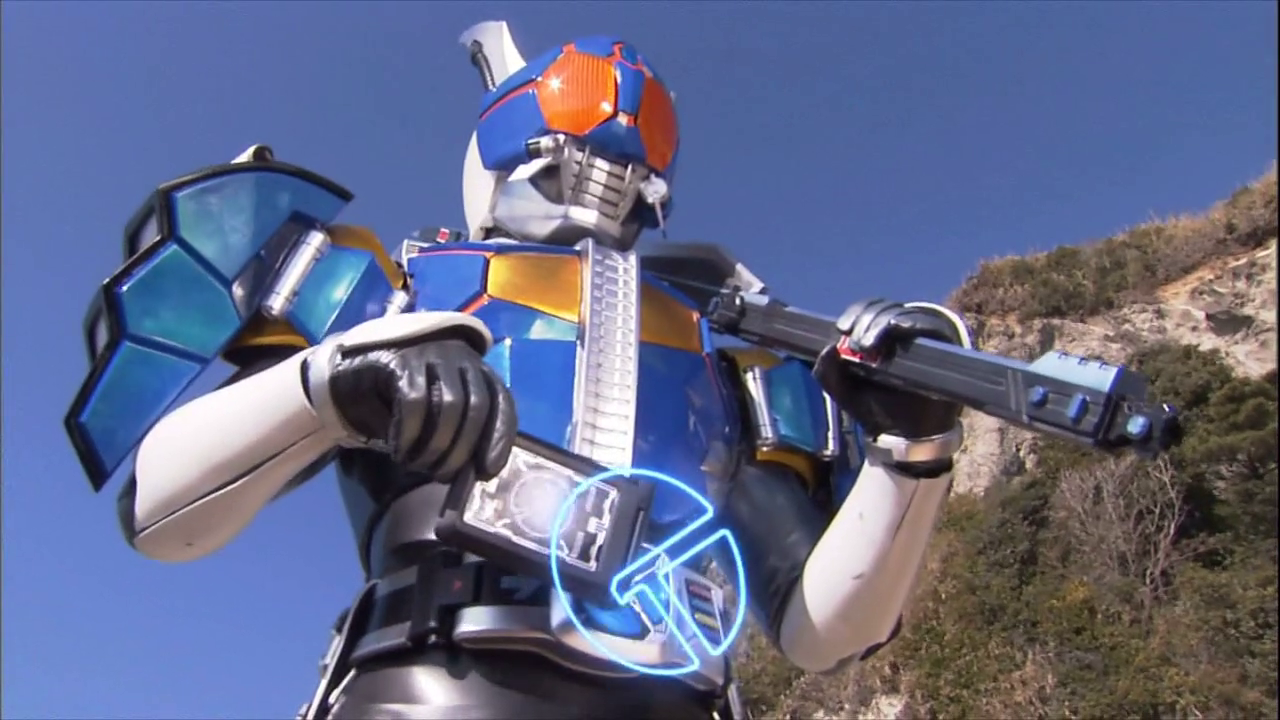
I enjoyed the Den-O henshin sequence and form switching very much, and I think the sound effects from the belt are really cool.  Same goes for Zeronos.   The suits themselves look a bit strange at first, especially Den-O's sword form.  It took me a little bit to realize what the suit design was based off of.  You have the more obvious train motif, but then you have the peach-like "eyes" descending and splitting in two, a clever and appropriate approach to Momotaros's form, considering the tale that his name references.  The derpiest thing was the "Moooo" sound during the Zeronos transformation.  I almost facepalmed at it, but it's kinda funny.  I grew to appreciate it eventually.

Zeronos Vega Form

In addition, I am pretty fond of the four Taros, Sieg's, and Deneb's designs.  They are just cool enough to take seriously, but are kind of cute in a way.  The other Imagin are not as memorable in terms of design.  I don't really remember ever thinking, "Man that guy looks really cool."

Music


The music in Den-O is much like most other things in the show:  Fun.    The BGM is a little jazzy, with heavy use of brass instrumentation.   There are a couple of stand-out string-heavy dramatic tunes as well.  The opening theme by AAA is great, but the ending themes are some of my favorites.  Double Action Sword Form and Action Zero rank up there for me as far as awesome Rider ending themes go.

The Den-O Movies


So before I give my final thoughts, let me mention the Den-O movies.  The first movie is practically a must-see, because it is tied into an arc in the series, so if you want the conclusion, you have to watch it.  There's also a Dickeido crossover, which I haven't watched yet (and may not).  Decade-related movies have a history of being kinda meh to me.

The third Den-O movie was pretty interesting.  It introduces Kotaro Nogami, Ryotaro's grandson, who becomes New Den-O.  He is joined by his Imagin partner, Teddy, who can transform into a gun/machete thing.  I was surprised at how easily I ended up accepting Kotaro and New Den-O.  Teddy is great.  He is extra-polite, but much less derpy than Deneb.  The four Taros butcher his name, of course, calling him Tendon.

New Den-O and Teddy

There's also the Chou Den-O Trilogy.  I was especially excited about Episode Red, which seemed to promise tying up some loose ends for Yuto and Airi.  Unfortunately, by the time these movies were made, Takeru Sato was no longer acting as Ryotaro, so they got the kid that played young Ryotaro in the first Den-O movie to play him.  I was not terribly thrilled about this, though I see why they did it.  It didn't help that Episode Red had way too much Ryotaro and gang when it really needed to be focusing on Zeronos.  If they had just somehow left Not-Ryotaro out or at least kept his presence to a minimum, I think I would have enjoyed it more.  The ending was pretty touching, though. 

Airi

I also viewed Episode Blue, which focuses on New Den-O and Teddy.  It still has Not-Ryotaro and gang, but I didn't feel like they stole the spotlight or anything.  It was quite enjoyable and a bit stronger than Episode Red.   I have not viewed Episode Yellow yet, though I do know it focuses quite a bit on Kamen Rider Diend.  I think I will need to see more Dickedo before I watch it.

Conclusion


Whew, I know this was a very long-winded look at Den-O.   I guess I had a lot of thoughts on it.  It doesn't help that I also tend to write informatively for those who haven't seen the show yet and just want an opinion/review on it before delving into things.

Overall Kamen Rider Den-O is a great show.  It is by far the silliest and most light-hearted Heisei Rider show that I have ever seen, and yet I don't have a problem with that.  It was very entertaining, and if you like FUN, then you should like Den-O.  Just don't go into it with unfair expectations, and give it a chance.  You won't regret it.

Thursday, November 22, 2012

It's Space Time! Thoughts on Kamen Rider Fourze

Well, Fourze's been over for a while now, and I've been out of the blogging mood/busy for some time.  Now that I have some quiet time before Thanksgiving, I'll probably churn out a few thoughts on various things.  Why not start with some thoughts on Kamen Rider Fourze, since it's still fairly fresh in my mind?


Plot


Kamen Rider Fourze centers around the school days of punkadour-sporting Kisaragi Gentarou as he tries to make friends with everybody at Amanogawa High School, a place very much focused on space and science.  One of his first challenges is befriending Utahoshi Kengo, a somewhat sickly student whose late father worked on utilizing mysterious space technology known as switches.  Kengo isn't much of a fighter due to his poor physical condition, and he relunctantly lets Gentarou use the Fourze driver to power up and fight the Zodiart monsters that pop up at AGHS.


Fourze with Rocket and Drill switches activated.

The interesting part is that the Zodiarts have their own switches, and are usually AGHS students that have been tempted to use the switches' powers by the enigmatic Horoscopes, higher-ups in the Zodiart chain of command.  Gentarou and his ever-growing club of friends essentially save these stray students, defeating them to destroy the switches.


The first ten or so episodes focuses on Gentarou befriending the characters that come together to form the Kamen Rider Club.  They have a sweet base on the moon (The Rabbit Hatch), linked by portal to a locker in a largely unused back room of the school.  Kengo spends time at the Rabbit Hatch developing new switches for Fourze, based on his father's previous work.

Eventually, a new Rider shows up.  Ryusei Sakuta transfers to AGHS, wielding the power to transform into Kamen Rider Meteor.  He wishes to find the Aries Zodiart, as it may hold the key to reviving his comatose friend.  Under orders from Tachibana, a masked benefactor from the Anti-Zodiart Alliance, Ryusei is to infiltrate the Kamen Rider Club.  As a result, Meteor's identity remains a secret for quite some time.  Of course, even Ryusei isn't any match for Gentarou's friending abilities, and they go from rivals to close allies over time.

Your fate is mine to decide.

Things escalate as Gamou, the leader of the Horoscopes, gathers the Horoscope switches for his sinister purposes.  It's all pretty spoilerific, so I won't go into much detail.

Many early episodes of Fourze contain a combination of some of these events:  New Zodiart appears, The Kamen Rider Club investigates, Fourze fights the Zodiart and saves the switch user, Gentarou befriends someone (often the switch's user, even).  As previously mentioned, the first ten or so revolve around the students that join the Kamen Rider Club, so there's a lot of time devoted to getting the KRC set up, making it take a while for the plot to really take off.

Overall, the plot can be a bit formulaic, but that's fairly normal for toku.  Things get serious toward the end, but I couldn't help but feel that it was a bit rushed.  The series is also not quite 50 episodes.  I bet if they had a few more episodes or better utilized some of the less plot-driving episodes, the pacing would feel a bit more even.  I was a tad disappointed in the ending.  It seemed too...familiar in some ways, and it wasn't quite the epic conclusion I was looking for.

 Characters


Fourze has a large and interesting cast of characters.  The Kamen Rider Club seems to double as both a strength and a weakness for the show.  The interactions between the KRC members is enjoyable, but because of the larger cast, less time can be spent on individual character development.

Gentarou is an interesting lead.  His absurdly friendly attitude combined with his carefree, punkish look give him a distinctive feel.  He stands out quite well among the other Kamen Rider protagonists.  All of his actions seem to be motivated by friendship.  It's quite literally his source of power, as can be seen when Fourze's Cosmic States form debuts.  Gentarou doesn't have much of a background story, other than the fact that he lives with his grandfather, who is a goofball much like he is.  His development revolves around the friendships he builds with everybody else, but by himself, he's not terribly deep.


Kengo and Jojima Yuki are arguably the most important of the Kamen Rider Club characters.  Kengo builds a slow and reluctant friendship with Gentarou, but it becomes very strong later on.  He is the at the center of quite a few important plot developments.  Yuki is a goofy trainwreck of a girl, but is Gentarou's only friend at AGHS when the show starts.  She's obsessed with space and can be seen prancing around with her Hayabusa plush.  She's cute, especially when she mimics Fourze's transformation and poses, but she can also be annoying at times.


We also have Tomoko, the weird goth girl.  Scenes with her are usually pretty entertaining, and sometimes she even emits a tangible, creepy aura.  She's one of my favorite KRC members, and later seems to possibly have a bit of a thing going on with Ryusei/Meteor, but nothing really becomes of it on-screen.  Her keen insights help the KRC on several occasions.  There's also Miu, the bossy cheerleader and Queen of AGHS, who takes somewhat of a leadership position over the Kamen Rider Club.

Tomoko during one of her creepy moments.
Tomoko's reaction to people seeing her without makeup.
Honestly, she's quite attractive.

Anyway, enough Tomoko pics.

Of course, there are more KRC members, including Shun, the football player and King of AGHS.  He is portrayed as the typical jock at first, but turns into a useful member of the KRC, piloting the Power Dizer to help Fourze knock some sense into the Zodiarts.  Last but not least is JK, a cowardly, yet stylish guy that seems to know just about everybody.  The guy has some trust and friendship issues, but he is useful for digging up information.

Miu and JK.

Of course, Ryusei (Kamen Rider Meteor) later joins the gang.  He quite a prick at first, pretending to be a quiet transfer student to weasel his way into the KRC while actually being a spy.  He finds himself at odds with Gentarou and even fights him sometimes in order to accomplish his own goals/purposes.  Eventually,  his identity as Meteor is revealed (in epic fashion).  Gentarou shows Ryusei the ways of friendship, and they become close allies, with the KRC accepting him with open arms.

Ryusei's typical look of mild annoyance.

And that's just the Kamen Rider Club.  Most of the big villains are actually school faculty or administrators, though a student or two become Horoscopes as well.  Some of the teachers are good guys, though.  Mr. Ohsugi, for example, is a good-hearted guy that serves as comic relief (as if the show really needs it).  Almost every scene he is in is absurdly goofy, and he isn't terribly helpful.


Poor, heartbroken Ohsugi.

Overall, Fourze has likable characters, but perhaps too many of them.  When every KRC member gets a story arc or two to themselves, you can imagine how many episodes it takes up.  This kind of thing sometimes happens in Sentai shows where each of the characters gets rotated development arcs for awhile, sometimes resulting in the character development getting spread a bit thin.

Fights/Visuals/Music


The fights are one of the best things about Fourze.  Gentarou has a clumsy way of fighting that is entertaining to watch.  However, he makes up for his poor fighting technique by utilizing Fourze's many switches.  Gentarou ends up with many switches at his disposal, and he utilizes some interesting combinations.  However, the "regular" switches get neglected a bit as he obtains Electric, Fire, Magnet, and Cosmic States.  There are so many possibilities and combinations, but Fourze's powers get handled poorly as Gentarou later spams the abilities of Fourze's alternate states.

Fourze Cosmic States

Ryusei, on the other hand, is quite the martial artist.  He goes full Bruce Lee mode, complete with "Wacha!" sounds.  Unfortunately, like with Fourze, Meteor's powers are handled poorly, in my opinion.  He has some nifty planet powers that he can imbue his fist with, but he uses them only at first, and they seem to mostly be forgotten later for some reason.  Meteor actually isn't around too long before he get his upgraded form, Meteor Storm, which utilizes a rod with a beyblade-like top attachment that he can fling at enemies.  Honestly, I think the Meteor Storm form is pretty ugly.

Meteor Storm

Some Kamen Rider fans were repulsed at the suit designs for Fourze.  I admit that they were a bit odd at first, but I grew to like Fourze and Meteor's base forms in particular.  Fourze's alternate forms are okay, though Cosmic States is easily the coolest.  The Zodiart designs are rather cool as well.


The special effects are fairly solid throughout the series.  There are quite a few space scenes and battle effects that make heavy use of CG, but overall, it is done well (for toku), at least in comparison to some of the earlier Heisei Kamen Rider shows.

The music in Fourze is pretty good and feels appropriate.  The BGM utilizes an upbeat, electronic feel, though I can't say that many BGM tracks stand out to me.  The opening is fun and catchy, but the ending themes were hit or miss for me me.  Giant Step and Cosmic Mind are easily my favorite picks.

Conclusion


Kamen Rider Fourze is a fun romp.  It can get a bit tiresome in spots, but it managed keep me mostly entertained week after week.  Unfortunately, it does suffer from some issues that were poorly-handled, as mentioned earlier, and I'd say that it isn't nearly as strong as W or OOO, but it's certainly not a bad entry in the Kamen Rider series.  It's worth a look, and should definitely put a smile or two on your face.


Tuesday, April 3, 2012

Could it be Golgom? Thoughts on Kamen Rider Black


Aside from the stuff made available in America, Kamen Rider Black is the first toku show that I got into.  Some people suggested it as a decent starting point for getting into Kamen Rider, and I thought the designs were cool, not to mention that the title carried with it an implication that it was a bit of a darker entry in the series.

I have been picking at Black for quite some time, as Century Kings has been slowly churning out episodes throughout the span of several years.  (No hating on Pal, he did a great job.)  CK finally finished all of the subs, so after seeing all of the episodes, I feel like I can give some thoughts on the series as a whole.

The series starts out with a feeling of darkness and desperation, as we see Minami Kotaro running and hiding from three floaty priest-looking dudes.  You quickly find out that they don't want to kill him.  Rather, with the help of his foster father, Kotaro has escaped the evil organization, Golgom, and they want him back because they have modified him to be Black Sun, one of the two century kings that will battle to become Golgom's new creation king.  During this pursuit, which is full of cheesy but lovable mid-80's special effects, the Golgom priests eventually catch up with Kotaro. After getting smashed through a wall, Kotaro emerges all steamy-like as the transformed Black Sun.


Long story short, he proves to be difficult to capture in this new form, and vows to stop Golgom and rescue his friend/stepbrother, Nobuhiko, who is being transformed into the other century king, Shadow Moon.  He takes the name of Kamen Rider Black and becomes a friend of justice, stopping Golgom's crazy plots and annihilating their mutants.

Minami Kotaro is a likable guy, and he possesses many of the heroic qualities of his Kamen Rider predecessors.  One thing in particular that I love about Kotaro is his intensity.  He has that way of getting visibly angry about Golgom's latest plot, glaring, yelling something about how it is "Unforgivable!", and clenching his fists, which often begins the Black transformation.  I think that Tetsuo Kurata deserves a lot of credit for his acting as Minami Kotaro.  He is truly great.  Even the Black transformation itself is a bit intense, with the snappy arm movements, and the steam erupting from Black's armor.  The whole package is just pure badassery.

Intense

Kotaro is not alone, however.  Kyoko, Nobuhiko's younger sister, is essentially Kotaro's sister as well, and she is one of his few sources of support, even if his struggles as Kamen Rider Black are unknown for the majority of the show.  Also there for Kotaro is Katsumi, Nobuhiko's girlfriend.  She has no idea what happened to Nobuhiko at first, and the revelation of Nobuhiko's fate becomes a very important event in later episodes.

Black's fight sequences can be a lot of fun, sometimes a little silly or awkward, and sometimes surprisingly brutal.  Black himself has a very rough and tumble kind of fighting style, and he utilizes plenty of grappling and throwing.  He has a number of special attacks, many of which are only used once, unfortunately.  His Rider Punch and Rider Kick are the staple moves, and they get upgraded to more powerful, seizure-inducing versions later on.  (I'm just kidding about the seizures, though the effects are really bright and flashy.)  The fights do tend to get a little bit repetitive, though Black gets beaten up quite a bit.  When he's in a jam, he relies a lot on Battle Hopper, his bro-tier, sentient grasshopper bike.  Later in the series, he gets a second bike, Road Sector, which drives at ludicrous speed and can pretty much drive straight through anything.


It's easy to start comparing Black to both Showa and Heisei shows, simply because it's kind of that awkward middle child.  It's right at the end of the Showa era, and Black RX is the only show that separates it from Kuuga, the first Heisei series.  RX is arguably Black Season 2 anyway.  I think viewers going from mostly Heisei shows to watching Black may feel underwhelmed, especially since the show gets some hype.  The special effects are, of course, not going to be as great as modern shows, and the plot is more episodic, with less of that J-Drama type stuff that many Heisei shows exhibit.  On the other hand, viewers that have seen mostly Showa era shows may hone in on the fact that for its time, Black is a darker, more serious series with special effects that are an improvement over previous shows.


One main criticism of Kamen Rider Black that I've heard expressed is that the show pretty much hits a plot brick wall for half of the series, until Shadow Moon shows up.  This is somewhat true.  The plot is very slow, and the show is susceptible to Golgom crazy plot of the week + monster of the week kind of shenanigans, though honestly, all of the Showa Rider shows are like that, so my comments above apply here as well.  In any given episode, Kotaro will be just riding through town, and something slightly out of the ordinary will just happen to occur in front of him, prompting him to ask, "Could it be Golgom?!" or some variant of that.  And of course, it turns out to be a zany Golgom plot every time.  It's actually fairly amusing.


The show tries to change things up a bit in the first half by introducing Sword Saint Birugenia, a would-be Golgom century king who is risen after thousands of years.  The guy is really tough, and he definitely has something to prove, going way out of his way to show up the Golgom priests.  There are also a couple of kidnapping plots by the priests to use Kyoko's life force to speed up Shadow Moon's birth.  Of course, once Shadow Moon finally awakens and the Golgom priests get upgraded, the plot moves much more quickly until the end.

Sun, I am disappoint.

Now, onto the music.  The opening and ending songs for Kamen Rider Black are great.  Tetsuo Kurata wasn't exactly Japan's next singing idol, but he did a great job of making his own theme song sound epic and badass, especially when he's in the deeper portion of his range.  There are also many insert songs, all sung by Toshiya Igarashi.  Henshin! Rider Black is a favorite of mine.  It's a treat when they use it alongside the transformation sequence.  The BGM for Black is pretty good as well.  It wasn't anything that made me want to go out and immediately find the OST, but it was pretty epic and appropriate for the feel of the show.

Hmm, after I talk about the music, that usually means I've run out of things to talk about, so time to wrap it up.  I may be a little biased since Kamen Rider Black was my first Rider show, but it definitely stands out as one of my top picks.  I won't call the show itself my absolute favorite, but Kamen Rider Black is probably my favorite Rider.  That being said, go out and give it a try if you haven't already, whether you're coming from Heisei or Showa or even no Rider shows at all.